Your instincts are already extraordinary.
Relational Learning makes them work at scale.
Relational Learning transforms any classroom into a place where every learner achieves excellence at their own pace in as little as eight weeks.
100,000+
Students learning with Relational Learning
22%
Average reading improvement in year 1
5,000+
Educators trained per year
30 minutes
Time to personalize learning for all students with AI
Our Purpose
Learning isn't something done to students — it's something that lives within them, waiting to be drawn forth.
The meaning of the word Education: from the Latin "educere" — to bring forth from within.
Who Learning One to One Serves
The right path for your role
Whether you lead in the classroom, run a school, or lead an entire education system, Relational Learning meets you where you are.
For Educators
Become more productive. Teach your students how to learn. Use the Relational Learning Framework and ARIE to personalize learning for every student in 30 minutes.
For Schools
Transform your institution into a place where every student achieves excellence. The framework works with all requirements, technology, and resources — any structure you already have.
For Educational Leaders
Schools in multiple countries have seen measurable gains in standardized scores from Year 1. Build a scalable professional development pipeline for your entire system.
THE METHOD
The Six-Step Relational Learning Framework
Developed through decades of research, the Relational Learning Framework turns all educators into a catalyst for excellence — regardless of their experience level, the curriculum, or the country. Your students develop life skills while learning the required curriculum.
Get started Read the book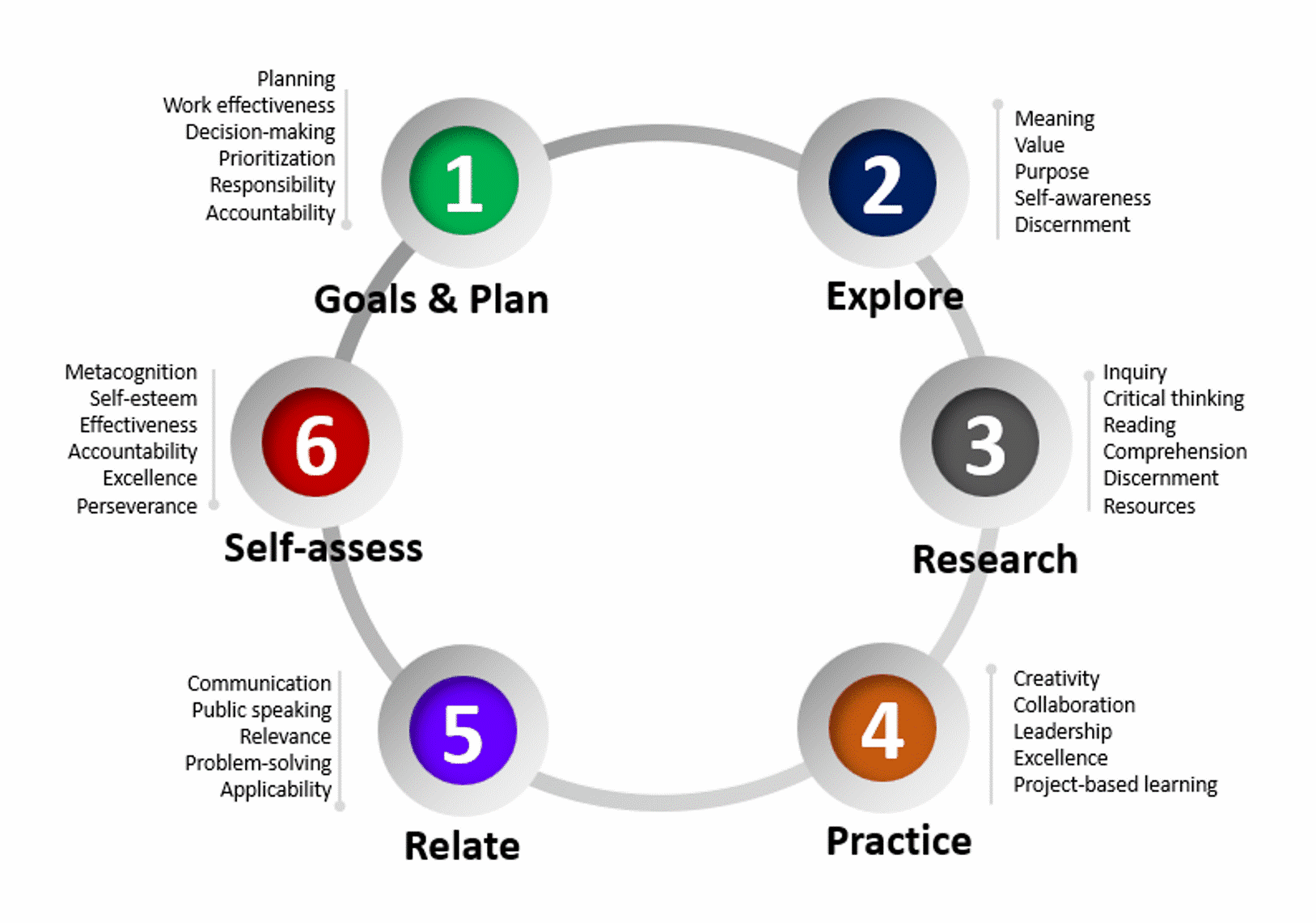


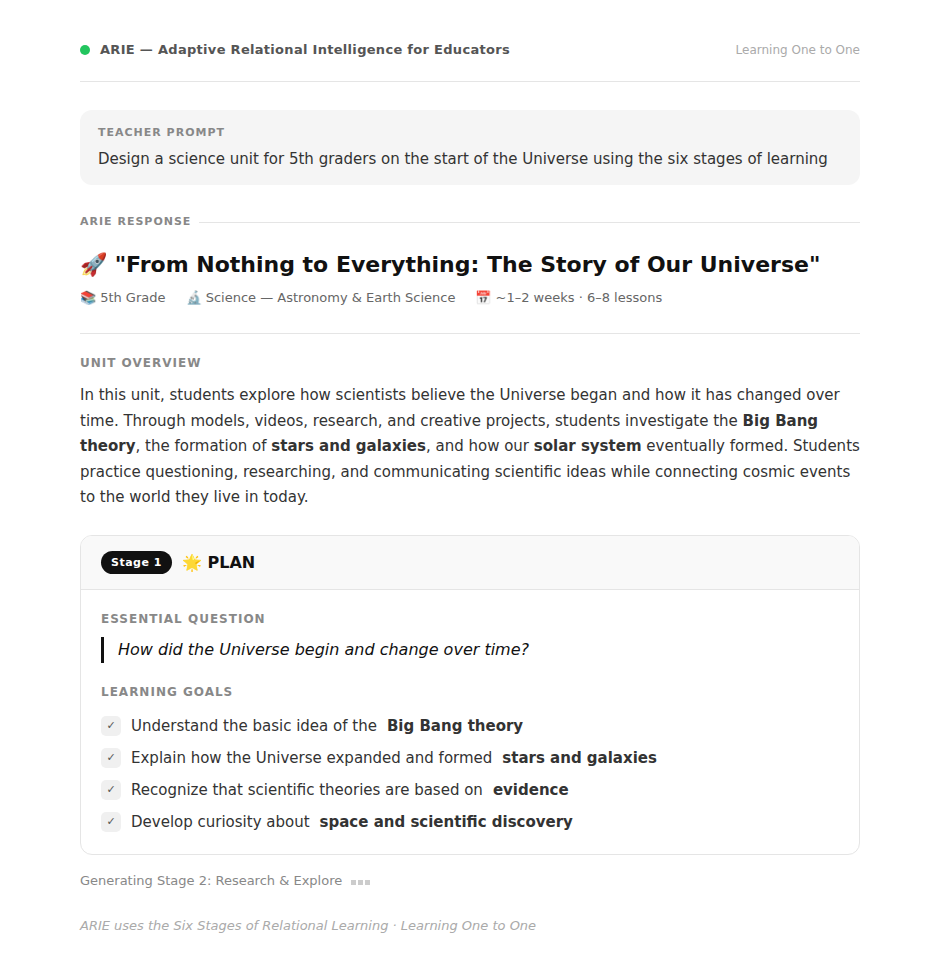
Meet ARIE, your Adaptive Relational Intelligence for Educators
Our research found that teachers typically spend four hours planning a lesson. With ARIE, that becomes 30 minutes — including full personalization for every single student in your class.
* Personalized learning plans for each student.
* Reduces lesson planning time by over 85%.
* Adapts to any curriculum or national standard.
* Translates lessons to multiple languages.
* Works for students of all ages and learning profiles.
Get startedSTUDENT OUTCOMES
What students gain for life
Relational Learning goes far beyond academic performance. It fosters the whole person, equipped for the AI Era.

Intellectual autonomy
Students learn to research, organize, and build knowledge independently — owning their intellectual growth.

Emotional Intelligence
From their emotions, students build a meaningful life, strengthen self-esteem, and develop resilience for challenges.

Social Leadership
Students set common goals, develop leadership, make collaborative decisions, and transform their social environments.

Creativity and Critical Thinking
Problem-solving, critical thinking, and creative excellence — skills that have a direct impact in their future with AI.

Time Management
Students become disciplined decision-makers who plan ahead, take responsibility, and thrive in challenging situations.

Responsibility
With a clear vision of their role in society, students of every age add genuine value to the world around them.

Innovation Mindset
Productivity and innovation begin at the earliest stages of education — and Relational Learning lights that fire early.

Excellence
Quality is constant. Time is variable. Students move from content consumers to true actors in their own learning experience.
EDUCATORS VOICE
Educators Across Continents
Speak for Themselves
Your Personalized Professional Development
Understand what you practice the most with your students, and build your next Relational Learning Professional Development from where you are. The 10-minute Compass Assessment will help you with that.
Take your PD assessment
QUESTIONS
Honest answers to what educators really ask
Relational Learning enables students to move from “content consumers” to actors in their learning experience, having personalized guidance from their educators. Quality becomes the constant, and time the variable. Students are respected for their differences so that their potential is fully explored. They are challenged to the best of their abilities, enabling them to succeed academically and in their lives. The impact extends beyond academic performance, including reductions in school dropout, failure, and educator effectiveness.
A personalized experience that fosters Learning Autonomy increases the academic and life success rate by developing each student's potential and creating a path for lifelong learning. It reflects what the word “education” really means from Latin: “to bring forth from within.” Students practice every day for 12 years to achieve excellence in everything, to never leave gaps, and to always find meaning in their work. This will be reflected in their adult lives, making them better professionals, better family members, and better citizens. The quality of their lives is directly linked to their relationship with the world. That is why it is called Relational Learning.
An Educator develops the faculties and empowers a student. The role of an Educator in Relational Learning is to be a catalyst for excellence – a facilitator of learning – and to foster the very best in every student. Learning how to work and educate will require an open-minded approach. The Educator goes through the same learning process as their students and thus better understands the challenges students face.
Relational Learning is a pedagogical model and a learning system. That is why it can incorporate any curriculum requirement, as it focuses on how students learn. Therefore, the Students’ Personalized Learning Plan incorporates full curriculum requirements included by educators in each country. Students are empowered to set daily, weekly, and monthly goals, fostering self-esteem and autonomy. By working on these goals, they learn to develop strategies to achieve them, enhance their strengths, and address their weaknesses.
Public schools using the Relational Learning Framework have improved academic performance in as little as six months.
You should expect a maximum of 10 hours, depending on your personal pacing.
In traditional schooling systems, quality and assessment are often related to grades: at the end of the year, students can be promoted to the next grade with a gradebook full of A’s, B’s, or even C’s. In Relational Learning, assessment is personalized so that every student reaches excellence, taking into account a personalized set of criteria that includes content mastery and cognitive skills development. Students are expected to demonstrate mastery of the content and skills mandated by the curriculum, but, first and foremost, they are expected to reach their own excellent level in each task they work on. Nevertheless, to comply with administrative requirements, each school determines how grades are given at the end of the year, but grades are assigned solely for administrative purposes, not as a measure of success, since quality is non-negotiable throughout the learning process.
In many contexts, standardized tests remain the norm, and Relational Learning acknowledges the need to put students in the best position possible to pass them. The Relational Learning Framework can be implemented to fulfill and surpass the requirements of any curriculum. Since this methodology focuses on how students learn, they develop skills and learning processes that ensure their success in any personal or academic endeavor, including standardized tests. Among other things, students develop reading comprehension and analysis skills that further help them succeed in tests. But more importantly, they take on the challenge and develop the determination, motivation, and sense of accountability needed to put in the necessary effort to reach their goals. They succeed because they know how to do so, and mostly because they want to improve! Public schools using Relational Learning have seen an increase in their students’ standardized test scores since the first year of implementation, regardless of country, required curriculum, or context.
If Relational Learning somewhat reminds you of Montessori, you are not that wrong, but there are several essential differences you need to be aware of. Montessori education emphasizes independence, freedom within limits, respect for the child’s development, uninterrupted blocks of work time, freedom of movement, and mixed age groups, among other things. But it is primarily designed to serve children aged 2 to 6. The Relational Learning Framework focuses on how students learn and serves students of all ages, including college students, throughout their lives, and can be implemented while meeting the requirements of any curriculum. The methodology is continually evolving, as it relies on Research and Development to ensure appropriate, proven solutions to the challenges of our ever-changing world.
An autonomous learner can grasp the world without an intermediary, using their own skills. Student agency means the ability to make decisions, set goals, establish plans and strategies to reach them, ask questions and find their answers, see problems, propose solutions, and overcome challenges. The Relational Learning Framework helps students become autonomous learners, develop 21st Century Skills, and lead successful and fulfilling academic and personal lives, developing their skills to their fullest potential. Educators provide the necessary support and framework for students to become autonomous learners and succeed on their own. Student agency means learning to work to reach their own dreams. Who wouldn’t want that?
The misconception that students want everything done for them is common. Would we like our mothers to feed us or change our diapers for the rest of our lives? Would we like to have someone to hold our hand to cross the street forever? We reach independence on these basic things and many others, so why should we want to depend on teachers to learn? Having an active role in their own learning process allows students to tap into their interests and strengths, rather than feeling constantly forced to focus on their weaknesses. Mistakes become learning opportunities, rather than negative results. Differences are respected and encouraged, rather than erased. Once students experience agency, guided by their educators, they become the most valuable advocates of their own ability to learn autonomously.
Reaching excellence and developing each student’s potential are central objectives in Relational Learning. Time is variable, and excellence is a constant. This means that students develop their skills at their own pace, but always need to work to their full potential to reach excellence. The effort put into each goal matters most because it is the element that will eventually make a difference in students’ lives: as long as students strive for excellence, rather than A grades or quick fixes, their academic and personal lives are set for success.
More often than not, school systems require grades. So while using the Relational Learning Framework, schools are welcome to devise and maintain their own grading system. Nevertheless, when Relational Learning is fully implemented, grades become progressively meaningless. Let’s put it this way: if every student strives for excellence, every student is eventually an “A-student”, so why should we keep grading? Some students may need more time, resources, opportunities, or support to reach excellence, but they will all find their own path to it by benefiting from the Relational Learning Framework.
Families’ role is crucial, since parents and guardians are responsible for providing ongoing support and attention to students and for fully participating in their learning process. Families are well-positioned to observe and communicate any factors that may affect the learning process, which is why parents and guardians are welcome to access information about students’ learning and to communicate with the school as often as needed. Lastly, students’ families contribute to and build a community that supports students in their quest for learning autonomy and agency.
If your school has an IB Program, it is indeed great news, because Relational Learning complements it and takes it even further! IB students certainly strive for excellence and hard work, with programs that promote social, emotional, and physical well-being. While IB is a curriculum framework that determines what students should learn and how it should be taught and assessed, Relational Learning is a methodology centered on students’ learning processes, allowing them to develop ownership of their learning and thus reinforcing one of IB’s objectives.
Yes. The research is shared in the books "Becoming Einstein's Teacher" and "Becoming Einstein." You can get your copy on Amazon or at any bookstore worldwide.
Your Students are Ready. Are you?
Join over 100,000 students and 5,000 educators worldwide. Start today.
Partners